
If heavy rain hits while you are travelling in Japan
If you are in a dangerous area, evacuate by alert level 4. Do not wait for level 5. If the streets are already flooded and going outside is more dangerous, do not force your way to a shelter. In a flood, move to a higher place inside the building where water is unlikely to reach; for a landslide risk, move to a room far from the slope. Even so, safety cannot be guaranteed.
Official sources checked: 2026-10-12
Caught in heavy rain right now
- Everyone in a dangerous area must evacuate when a level 4 evacuation order (避難指示) is issued. People who need more time to move, and those helping them, should move first at level 3 evacuation of the elderly and others (高齢者等避難). Do not wait for level 5.
- Do not enter flooded roads or underpasses. If you are underground, follow staff instructions and head to the surface before water comes in. Stay away from rivers, ravines and steep slopes too.
- If the streets are already flooded, or going outside is more dangerous because of storms or landslides, do not push yourself to reach a distant shelter. Move inside the building you are in now: to a higher place where water is unlikely to reach in a flood, or to a room far from the slope in a landslide risk.
- If you need an ambulance, fire or rescue services, call 119. Tell them the name and address of the building you are in and what is happening. If you do not know the address, describe a nearby landmark such as a large building, and answer the questions you are asked.
Official sources: JNTO · Who should evacuate at alert level 3 (in Korean) ↗ · JNTO · What to do when a level 4 evacuation order is issued (in Korean) ↗ · JNTO · Why you must not wait for level 5 (in Korean) ↗ · Japan Meteorological Agency · Inundation risk map and underground safety (in Japanese) ↗ · Japan Meteorological Agency Sendai office · Places to avoid in heavy rain (in Japanese) ↗ · Cabinet Office · How to evacuate and when you may stay indoors (revised March 2026, in Japanese) ↗ · Fire and Disaster Management Agency · How to call 119 and what to do if you cannot get through (in Japanese) ↗ · JNTO · Traveller support hotline and emergency contacts (in English) ↗
Sources checked:
How to read Japanese signs and notices
If you see the Japanese below on a sign or a phone alert, check what it means. Do not read the numbers alone; read together what danger is announced and which areas or sections it covers.
避難指示
Meaning避難指示 means everyone in a dangerous place must evacuate.
What to doIf you are in a dangerous place in the area covered by this guidance, evacuate. Do not wait for level 5.
This is a level 4 notice. Read the target area and issue time together. If the road is already flooded, do not force your way across.
Official sources: Japan Meteorological Agency · Weather information and alert levels (in Japanese) ↗
Sources checked:
高齢者等避難
Meaning高齢者等避難 means people who need more time to evacuate should move first.
What to doPeople who need more time to move, and those helping them, should evacuate from dangerous places first. Others should prepare to evacuate or move early if needed.
This is a level 3 notice. It covers not only the elderly but also people with disabilities, infants and small children — anyone who needs more time to move, and those who help them.
Official sources: Japan Meteorological Agency · Weather information and alert levels (in Japanese) ↗
Sources checked:
緊急安全確保
Meaning緊急安全確保 means a disaster has already struck or is about to strike, and you must protect yourself immediately.
What to doIf going outside is already more dangerous, protect yourself with what you can do now: move to a higher place inside the building where water is unlikely to reach, or to a room far from the slope.
Level 5 means the disaster has already happened or is imminent. Evacuate by level 4 instead of waiting for this notice. Moving to higher ground does not guarantee safety.
Official sources: Cabinet Office · Evacuation action guidelines (revised March 2026, in Japanese) ↗
Sources checked:
レベル4土砂災害危険警報
Meaningレベル4土砂災害危険警報 is the level 4 landslide danger alert.
What to doIf you are in a landslide risk area, check the risk map and the local evacuation guidance, and evacuate from dangerous places right away.
Japan Meteorological Agency alerts and municipal evacuation orders are separate. In a landslide risk area, evacuate early based on the risk level and surrounding conditions, even if no order has been issued.
Official sources: Japan Meteorological Agency · Landslide Kikikuru and evacuation (in Japanese) ↗
Sources checked:
運転見合わせ
Meaning運転見合わせ means train service is temporarily suspended.
What to doCheck notices for when your line and section will resume. Ask station staff whether another means of transport is available.
Even after the rain stops, services may not resume immediately because tracks need checking. Do not guess the resumption time or an alternative.
Official sources: JR East · Service suspensions in heavy rain and checks before resuming (in Japanese) ↗
Sources checked:
洪水・内水 / 土砂災害
Meaning洪水・内水 / 土砂災害: 洪水 is flooding from rivers overflowing, 内水 is water pooling on roads and in buildings because rainwater cannot drain, and 土砂災害 covers landslides and related hazards.
What to doFind your accommodation’s address on the hazard map. Look at the flood/inundation and landslide options separately, and find evacuation sites and routes that avoid each risk.
These words name the risk types you can select on the map. They do not mean water is there right now.
Official sources: Ministry of Land, Infrastructure, Transport and Tourism · Geospatial Information Authority of Japan · Hazard map portal (in Japanese) ↗
Sources checked:
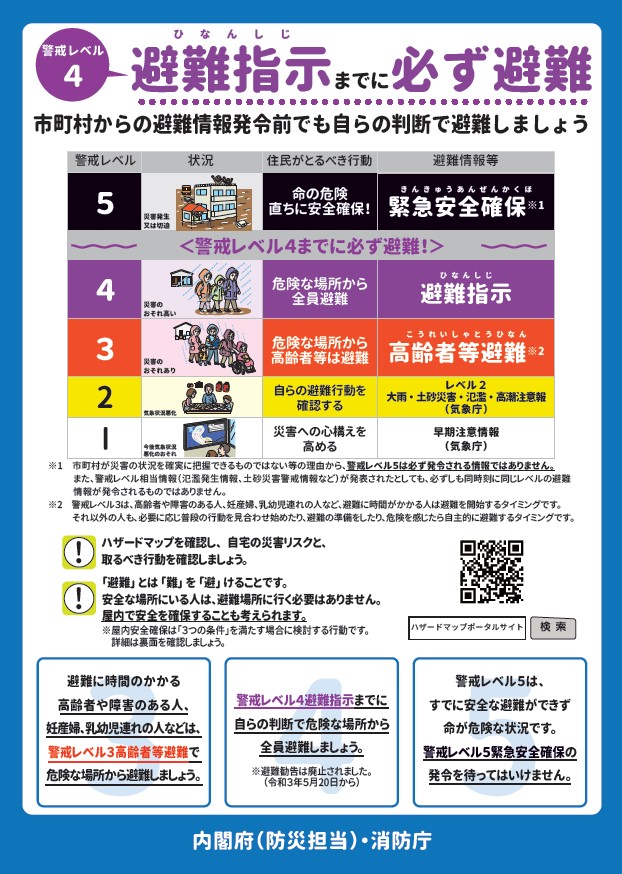
「避難指示」 means ‘evacuation order’. If you are in a dangerous place, you must evacuate by level 4. The numbers 1 to 5 mark different action levels; they are not rainfall amounts or water depth. This is official guidance on what to do, not a warning currently in force.
Source: Cabinet Office (Disaster Management) · Fire and Disaster Management Agency · PDL1.0 · Used unaltered · Terms of use
Source and terms of use checked:
Official sources: JNTO · Who should evacuate at alert level 3 (in Korean) ↗ · JNTO · What to do when a level 4 evacuation order is issued (in Korean) ↗ · JNTO · Why you must not wait for level 5 (in Korean) ↗ · Japan Meteorological Agency · Inundation risk map and underground safety (in Japanese) ↗ · Japan Meteorological Agency Sendai office · Places to avoid in heavy rain (in Japanese) ↗ · Cabinet Office · How to evacuate and when you may stay indoors (revised March 2026, in Japanese) ↗ · Fire and Disaster Management Agency · How to call 119 and what to do if you cannot get through (in Japanese) ↗ · JNTO · Traveller support hotline and emergency contacts (in English) ↗
Sources checked:
What should I know before I travel if heavy rain is forecast?
First, check whether your accommodation and the places you plan to visit are at risk of flooding or slope collapse. Find the address on a hazard map showing danger zones, and decide in advance where to evacuate and how to get there.
On days when heavy rain is expected, it is best to take riverside walks and trips to ravines or mountain paths off your itinerary. If you plan to change accommodation, check the hazard map and local guidance before the rain strengthens: is the new accommodation in a danger zone, and are the roads there at risk of flooding or landslides?
- Find your accommodation’s address and the addresses of places you will visit on the official map. Select 洪水・内水 (flood and inundation from rainwater that cannot drain) and 土砂災害 (landslides) separately to see which risks apply.
- Check which hazards the evacuation site you have in mind is designated for: flooding, landslides or both. Also look at the route: are there riversides, slopes or underpasses on the way? The shelters shown on the map are not all open that day.
- Before you leave and before each outing, look for your area’s name and the issue time in Japan Meteorological Agency warnings. Ask your accommodation’s staff where to receive evacuation guidance, and save the accommodation’s Japanese address and contact number on your phone.
- Check flood and landslide risk around your accommodation on the official map (in Japanese) ↗
- Read the meaning of weather warnings from JNTO (in Korean) ↗
- What cash, battery and medication to pack before you go →
Official sources: Ministry of Land, Infrastructure, Transport and Tourism · Geospatial Information Authority of Japan · Flood and landslide hazard map (in Japanese) ↗ · Geospatial Information Authority of Japan · Evacuation sites and shelters by disaster type (in Japanese) ↗ · Japan Meteorological Agency · Landslide risk map and when to evacuate (in Japanese) ↗ · JNTO · What weather warnings mean (in Korean) ↗
Sources checked:
At which level should I evacuate?
In a dangerous place, evacuate by alert level 4. If you need more time to move, move first at level 3. Do not wait for the level 5 special warning or emergency safety notice.
Municipal evacuation orders and Japan Meteorological Agency warnings are separate notices. If the agency has issued a warning matching level 3 or 4, also check the Kikikuru (キキクル) map, which colours areas by growing danger. If a landslide risk area shows red, people who need more time to move should start evacuating no later than then. If it turns purple, everyone else should leave dangerous places immediately. Do not wait for black.
Levels 1–2 · Know where to evacuate and how to get there
At level 1, watch the latest weather information. At level 2, find where you are on the danger-zone map, and confirm again where to evacuate and how to get there.
Level 3 · If you need more time to move, evacuate first
Older people, people with disabilities, and infants and small children — anyone who needs more time to move — and those helping them must evacuate from dangerous places first. Others should cut back on unnecessary outings and prepare to evacuate; move before level 4 if needed.
Level 4 · Everyone in a dangerous place must evacuate
Everyone in a danger zone under an evacuation order must evacuate. If the Japan Meteorological Agency has already issued information matching level 4, do not wait for the municipal evacuation order. Check the risk map and surrounding conditions, and move out of dangerous places.
Level 5 · Protect yourself where you are
The disaster has already happened or is about to. It may be hard to go far, so protect yourself in place as best you can. A level 5 notice may never come. Do not wait for it.
Official sources: Japan Meteorological Agency · What to do for each warning (in Japanese) ↗ · JNTO · Who should evacuate at alert level 3 (in Korean) ↗ · JNTO · What to do when a level 4 evacuation order is issued (in Korean) ↗ · JNTO · Why you must not wait for level 5 (in Korean) ↗ · Japan Meteorological Agency · Landslide risk map and when to evacuate (in Japanese) ↗
Sources checked:
If I am caught in heavy rain outdoors, what should I avoid?
Do not enter flooded roads or underpasses; move away from rivers, ravines and steep slopes. If you are underground, follow staff instructions and head to the surface before water comes in.
Do not cross flooded roads
Do not enter on foot or by car. On a flooded road, drains, open manholes and collapsed road edges may be invisible. Even if the water looks shallow, do not try to get through.
Do not go underground to escape the rain
Underground areas and underpasses can fill faster than the ground around them. Do not enter if there is a flood risk. If you are already underground, follow staff instructions and head to the surface before water comes in.
Move away from rivers and slopes
Do not go close to see how high the river has risen. Around steep slopes and ravines in landslide risk areas, do not stay put inside a building; evacuate early to somewhere outside the risk area.
Official sources: Japan Meteorological Agency Sendai office · Places to avoid in heavy rain (in Japanese) ↗ · Japan Meteorological Agency · Inundation risk map and underground safety (in Japanese) ↗ · Japan Meteorological Agency · Landslide risk map and when to evacuate (in Japanese) ↗ · Cabinet Office · How to evacuate and when you may stay indoors (revised March 2026, in Japanese) ↗
Sources checked:
What if going outside is already more dangerous?
If the roads are already under water, or landslides or storms make going outside more dangerous, do not force your way out. In a flood, move to a higher place inside the building where water is unlikely to reach; in a landslide risk, move to a room even slightly farther from the slope, right away.
This is a last measure to reduce risk when evacuation outside has become difficult. Water could reach upper floors, and earth could enter rooms away from the slope. Moving inside the building does not make you safe, so evacuate out of the danger zone before it comes to this.
If you plan to stay in your accommodation from the start when flooding is forecast, check three things in advance. Ask the accommodation and the municipality whether the building is outside the zone where collapse or being swept away is expected, whether your room is above the expected flood depth, and whether you can stay until the water recedes. Secure enough water, food and medication, and be able to cope without electricity, water or toilets.
Do not stay just because you are on the second floor or higher of a hotel. If the water is expected to rise above your room, or the building could collapse or be swept away, staying inside is dangerous. If there is a landslide risk, do not assume you can stay even if the three flood conditions are met. Evacuate out of the danger zone early.
Do not go back to flooded roads or dangerous buildings to collect your bags. If you need rescuing, call 119 from where you are.
Official sources: Cabinet Office · How to evacuate and when you may stay indoors (revised March 2026, in Japanese) ↗ · Japan Meteorological Agency · When you must evacuate a building in a flood (in Japanese) ↗ · Japan Meteorological Agency · Landslide risk map and when to evacuate (in Japanese) ↗ · Fire and Disaster Management Agency · How to call 119 and what to do if you cannot get through (in Japanese) ↗ · JNTO · Traveller support hotline and emergency contacts (in English) ↗
Sources checked:
Can I just go to the nearest shelter?
Do not choose by closeness alone. You need to check whether it can be used in a flood or landslide, whether it is open right now, and whether you can reach it.
- On the official map or the local shelter list, check whether a site can be used in a flood (洪水), a landslide (崖崩れ・土石流・地滑り) or in inundation from rainwater that cannot drain (内水氾濫). The place you went to for an earthquake may not be usable for a flood.
- In the municipal shelter-opening notice, find the facility name, your area and the issue time. Also confirm the facility is open right now. An evacuation site for escaping immediate danger and a longer-term shelter serve different purposes.
- If staff direct you somewhere else, ask where to go and which roads are passable. If the route is already flooded, do not force your way across. Protect yourself where you are — for example by moving to a higher place inside the building where water is unlikely to reach.
- Find evacuation guidance and open shelters for your area →
- How evacuation sites differ for floods and landslides (in Japanese) ↗
Official sources: Geospatial Information Authority of Japan · Evacuation sites and shelters by disaster type (in Japanese) ↗ · Cabinet Office · How to evacuate and when you may stay indoors (revised March 2026, in Japanese) ↗ · JNTO · What to do when a level 4 evacuation order is issued (in Korean) ↗
Sources checked:
Once the rain eases, can I return to my accommodation or continue my trip?
Do not set out for your accommodation or the station as soon as the rain eases. First check whether evacuation guidance is still in place and whether your route is blocked. Separately confirm that you can enter your accommodation and that your trains and buses are running.
Even where the rain has eased, flooding risk can rise later from heavy rain upstream. Trains can stay stopped until track and slope inspections finish after the rain ends. Do not assume the danger is gone or transport is back just because the rain has stopped.
- First find out whether warnings or evacuation guidance are still in place where you are and where you are heading, and whether roads are closed. If your route is still flooded or landslide risk remains, do not rush to move.
- Call the hotel to ask whether you can enter your room and whether there are closures on the way there. If you cannot stay at the accommodation, tell shelter staff that you are travelling and have nowhere to stay.
- If you are heading home, check your booked flight and the trains or buses to the airport separately. In the operator’s official notice, find the line and section you will take and see when it was issued. If there is no notice that service has resumed, it is better not to rush to the station or airport.
- If you need to change or cancel a booking, ask the airline, accommodation or seller how to apply and what it costs. A disaster does not mean every booking is cancelled free of charge or that another room will be provided.
- Find official disaster and transport information from JNTO (in English) ↗
- Check whether JR East trains are running (in Japanese) ↗
- What to do when your flight is delayed or cancelled →
- Finding transport for getting around Japan →
Official sources: Japan Meteorological Agency · Linear rain bands and flood risk (in Japanese) ↗ · JR East · Why heavy rain stops trains and checks before resuming (in Japanese) ↗ · JR East · Train operation and suspension information (in Japanese) ↗ · JNTO · Disaster and transport information (in English) ↗
Sources checked:
Who do I contact if I am hurt or need help?
Call 119 if you need an ambulance, the fire service or a rescue. If a disaster is causing you difficulty while travelling, you can call the JNTO traveller support line at 050-3816-2787.
Give 119 the name and address of the building you are in and what is happening. If you do not know the address, describe something that identifies your location, such as a large building or intersection, and answer the questions you are asked. If you cannot get through, ask nearby staff or people to call for you. Do not cross a flooded road to find somewhere to call from.
The JNTO line offers help in Korean, English and Chinese, 24 hours a day. From outside Japan, call +81-50-3816-2787. If you need urgent rescue, call 119 before contacting JNTO.
When you arrive at a shelter, tell staff that you are travelling and cannot stay at your accommodation, and ask for the help you need. If you have run out of medication or need to talk to a doctor, explain that too. Ask on site whether you can receive medication or supplies, request interpretation, and whether there is space to stay.
Official sources: Fire and Disaster Management Agency · How to call 119 and what to do if you cannot get through (in Japanese) ↗ · JNTO · Traveller support hotline and emergency contacts (in English) ↗
Sources checked:
Related guides
Frequently asked questions
If a level 5 special warning is issued, can I start evacuating then?
Do not wait for level 5. In a dangerous place, evacuate by level 4; if you need more time to move, move first at level 3. Level 5 is issued when the disaster has already happened or is imminent. The municipality may not be able to issue it, so do not wait for it.
Official sources: JNTO · Who should evacuate at alert level 3 (in Korean) ↗ · JNTO · Why you must not wait for level 5 (in Korean) ↗
Sources checked:
There is no evacuation order yet, but Kikikuru shows purple. What should I do?
If you are in a danger zone, do not wait for an evacuation order. Purple means alert level 4. In a landslide risk area, start evacuating from dangerous places immediately. If the roads are already flooded and going outside is more dangerous, do not force yourself to move; protect yourself in place as best you can.
Official sources: Japan Meteorological Agency · What to do for each warning (in Japanese) ↗ · Japan Meteorological Agency · Landslide risk map and when to evacuate (in Japanese) ↗
Sources checked:
Can I stay put in a flood if I am on the second floor of a hotel?
You cannot stay just because you are on the second floor. Check in advance whether the building is outside the zone where collapse or being swept away is expected, whether your room is above the expected flood depth, and whether you can stay until the water recedes. You need enough water, food and medication, and must be able to cope without electricity, water or toilets. If there is a landslide risk, do not assume you can stay even if these flood conditions are met.
Official sources: Cabinet Office · How to evacuate and when you may stay indoors (revised March 2026, in Japanese) ↗ · Japan Meteorological Agency · When you must evacuate a building in a flood (in Japanese) ↗
Sources checked:
What if the road to the shelter is already flooded?
Do not cross flooded roads on foot or by car. If going outside is more dangerous, move to a higher place inside the building you are in now. Call 119 if you need rescue. Moving to a higher floor does not make you safe.
Official sources: Cabinet Office · How to evacuate and when you may stay indoors (revised March 2026, in Japanese) ↗ · Japan Meteorological Agency Sendai office · Places to avoid in heavy rain (in Japanese) ↗ · JNTO · Traveller support hotline and emergency contacts (in English) ↗
Sources checked:
Can I use the evacuation site I went to for an earthquake in a flood too?
First check the official map and local guidance to see whether that site can be used in a flood. Evacuation sites are designated separately for each disaster type. Do not assume a site for earthquakes is also right for floods or landslides. Separately check whether it is open right now and whether the route there is safe.
Official sources: Geospatial Information Authority of Japan · Evacuation sites and shelters by disaster type (in Japanese) ↗ · Cabinet Office · How to evacuate and when you may stay indoors (revised March 2026, in Japanese) ↗
Sources checked:
Why are trains still stopped even though the rain has stopped?
Because rainwater stays in the ground and slopes can still collapse, and tracks and facilities must be inspected before trains run again. JR East notes that such checks can take time. Check the operator’s latest notice for whether your line is running and how far it goes.
Official sources: JR East · Why heavy rain stops trains and checks before resuming (in Japanese) ↗ · JR East · Train operation and suspension information (in Japanese) ↗
Sources checked:
If I cancel my trip because of heavy rain, can I get a free refund?
Heavy rain does not mean every booking can be refunded free of charge. Ask the airline, accommodation or seller how to change or cancel this booking, what it costs, and where to apply. If you need to evacuate, do not delay evacuating to ask about cancellation.
Official sources: JNTO · Disaster and transport information (in English) ↗ · JNTO · What to do when a level 4 evacuation order is issued (in Korean) ↗
Sources checked:
Official sources for this guide
Check current warnings and access restrictions in the notices for each area. For whether trains and flights are running, see the latest notices from the transport operators.
Official sources: Japan Meteorological Agency · What to do for each warning (in Japanese) ↗ · JNTO · Who should evacuate at alert level 3 (in Korean) ↗ · JNTO · What to do when a level 4 evacuation order is issued (in Korean) ↗ · JNTO · Why you must not wait for level 5 (in Korean) ↗ · JNTO · What weather warnings mean (in Korean) ↗ · Japan Meteorological Agency · Inundation risk map and underground safety (in Japanese) ↗ · Japan Meteorological Agency Sendai office · Places to avoid in heavy rain (in Japanese) ↗ · Japan Meteorological Agency · Landslide risk map and when to evacuate (in Japanese) ↗ · Cabinet Office · How to evacuate and when you may stay indoors (revised March 2026, in Japanese) ↗ · Japan Meteorological Agency · When you must evacuate a building in a flood (in Japanese) ↗ · Japan Meteorological Agency · Linear rain bands and flood risk (in Japanese) ↗ · Ministry of Land, Infrastructure, Transport and Tourism · Geospatial Information Authority of Japan · Flood and landslide hazard map (in Japanese) ↗ · Geospatial Information Authority of Japan · Evacuation sites and shelters by disaster type (in Japanese) ↗ · JR East · Why heavy rain stops trains and checks before resuming (in Japanese) ↗ · JR East · Train operation and suspension information (in Japanese) ↗ · JNTO · Disaster and transport information (in English) ↗ · Fire and Disaster Management Agency · How to call 119 and what to do if you cannot get through (in Japanese) ↗ · JNTO · Traveller support hotline and emergency contacts (in English) ↗
Sources checked: