
If a volcano erupts during your Japan trip
If you witness an eruption near a volcano or receive an eruption bulletin, stop sightseeing and climbing and protect your head and body. Take shelter in a nearby evacuation facility or move away from the crater following on-site guidance. Eruption alert levels show the hazard area and required actions in five stages. Level 1 does not guarantee safety. An eruption can occur suddenly before a warning is issued.
Official sources checked: 2026-10-12
If an eruption starts near the volcano
- Do not stay to take photos or go closer to the crater. Cover your head with a helmet or backpack, and watch for flying or falling rocks.
- Take shelter in a nearby volcanic evacuation facility or mountain hut. If there is none, protect yourself according to the situation, such as behind a nearby rock.
- Move away from the crater following guidance from managers, police, and firefighters. If rocks are falling or the descent is dangerous, you may need to take shelter nearby first. Whether to descend immediately or take shelter first depends on conditions on site.
- If you need an ambulance or urgent fire help, call 119. Tell them the volcano name, nearby facilities, and trail sign names to communicate where you are.
Official sources: Japan Meteorological Agency · What to do when you receive an eruption bulletin (in Japanese) ↗ · Japan Meteorological Agency · Eruptions and volcanic ash at Mt. Mihara (in Japanese) ↗ · JNTO · What to do when a volcano erupts before your eyes (in Korean) ↗ · JNTO · Traveler support line and emergency contacts ↗
Sources checked:
How to read Japanese signs and notices
When you see the Japanese below on signs or phone alerts, check what it means. Do not look at the numbers alone — read what danger is being announced and which area or section it covers.
立入禁止
Meaning This means you must not enter this area.
What to do Do not go beyond signs or barrier lines. If you are already in a restricted area, leave following on-site guidance.
Even if the volcanic alert level is low or others enter, do not enter restricted areas. The photo above is a past example, so check on-site guidance for current restrictions.
Official sources: Ministry of the Environment Chubu Regional Office · Murododaira no-entry signs and barrier examples (in Japanese) ↗
Checked:
火口周辺規制
Meaning This means entry around the volcanic crater is restricted.
What to do Read the restricted range in the notice and do not enter it.
This expression is used at volcanic alert level 2. Restricted distances differ by volcano, so do not approach the crater based on the level number alone.
Official sources: Japan Meteorological Agency · Volcano disaster info terms and cautions (in Japanese) ↗
Checked:
入山規制
Meaning This means entry to some mountain areas or climbing is restricted.
What to do Do not start climbing in restricted areas. If you are already inside, leave following staff guidance.
This is generally used at volcanic alert level 3. Do not stay in restricted areas to take photos or view observatories.
Official sources: Japan Meteorological Agency · Volcano disaster info terms and cautions (in Japanese) ↗
Checked:
噴火速報
Meaning This is a notice quickly informing that a volcano has erupted.
What to do If you are near the volcano, stop sightseeing or climbing and protect your head and body. Depending on the situation and on-site guidance, enter a nearby evacuation facility or move away from the crater.
This does not predict eruptions in advance. If you witness an eruption before the alert, do not wait for the alert.
Official sources: Japan Meteorological Agency · Meaning of eruption bulletins and actions (in Japanese) ↗
Checked:
退避壕
Meaning This is a volcanic evacuation facility to temporarily protect yourself from falling rocks.
What to do If rocks are falling from an eruption and it is nearby and accessible, enter following on-site guidance to temporarily protect yourself.
This differs from shelters for staying overnight. It does not block all volcanic hazards, and you must check on-site whether you can enter now.
Official sources: Japan Meteorological Agency · Eruptions, ejecta, and volcanic ash for Mt. Mihara tourists (in Japanese) ↗
Checked:
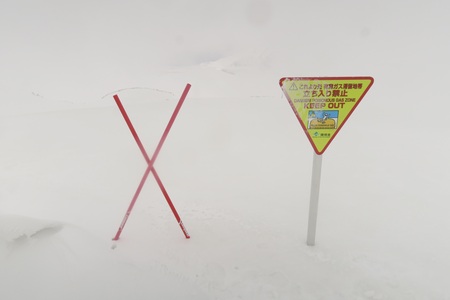
「立入禁止」 means no entry. Even if you cannot read all the Japanese, do not go beyond X-barriers or barrier lines. This is a sign example toward Jigokudani at Tateyama Murododaira; the photo is from April 12, 2018, so it does not show whether the road is open now or how much snow there is.
Credit: Ministry of the Environment Chubu Regional Office 「室堂平の利用について」 · PDL1.0 · Used unchanged · Terms of use
Sources and terms checked:
Official sources: Japan Meteorological Agency · What to do when you receive an eruption bulletin (in Japanese) ↗ · Japan Meteorological Agency · Eruptions and volcanic ash at Mt. Mihara (in Japanese) ↗ · JNTO · What to do when a volcano erupts before your eyes (in Korean) ↗ · JNTO · Traveler support line and emergency contacts ↗
Sources checked:
What should I check before visiting a volcano?
Check warnings for the volcano you will visit, and whether you can enter the crater and trails. Do not set out based on the alert level number alone; check places closed by local governments and facilities.
The Ministry of the Environment climbing guidance for Mount Aso · 阿蘇山 says not to enter trails restricted due to earthquakes, heavy rain, or volcanic gas. When visiting other volcanoes, follow entry restrictions for those places too. Roads may be closed for other dangers even without eruption warnings.
Even if evacuation facilities are marked on maps, check separately whether you can use them now. Do not assume evacuation facilities protect against all volcanic hazards.
- Find your volcano at JMA and see the warning issued time and hazard zones. Some volcanoes do not use alert levels, so even without a number, read the hazard area and action guidance in the warning.
- Find closed trails and observatories in local government or national park/facility notices. On-site, do not go beyond no-entry signs or barrier lines.
- Find nearby evacuation facilities and descent routes on volcano guidance maps in advance. Save needed maps and accommodation addresses on your phone in case the internet is cut.
- When climbing, bring equipment recommended for that mountain, such as helmets. If entry is restricted or preparation is difficult, consider removing crater-area plans.
- Find warnings and activity info for your volcano (in Japanese) ↗
- View hazard zones and evacuation maps by volcano (in Japanese) ↗
- Cash and emergency supplies to pack before Japan travel →
Official sources: Japan Meteorological Agency · Warnings and activity info by volcano (in Japanese) ↗ · Japan Meteorological Agency · Hazard zones and evacuation maps by volcano (in Japanese) ↗ · Japan Meteorological Agency · Meaning of eruption warnings and forecasts (in Japanese) ↗ · Ministry of the Environment · Where not to enter at Mt. Aso and climbing prep (in Japanese) ↗ · Japan Meteorological Agency · Eruptions and volcanic ash at Mt. Mihara (in Japanese) ↗
Sources checked:
Is alert level 1 safe to visit?
No. Even at level 1, remember it is an active volcano. Ash and ejecta can spew from the crater, and levels do not always rise in order.
JMA announces hazard zones and needed actions in five eruption alert levels (噴火警戒レベル). Even at the same level, restricted ranges and evacuation methods differ by volcano. Do not apply another volcano's restricted distances or evacuation guidance to the one you are visiting.
Level 1 · Does not mean safe
Check activity info for your volcano and follow on-site guidance. You may not be able to enter the crater depending on conditions.
Level 2 · Do not enter around the crater
See hazard zones in warnings and on-site barrier lines, and do not go to restricted areas around the crater.
Level 3 · Stop climbing in restricted areas
Do not enter areas with climbing bans or entry restrictions. Do not continue sightseeing at observatories in restricted areas.
Level 4 · People who need help evacuating move first
In evacuation-target residential areas, older adults and others who need help evacuate first, and others must prepare to evacuate. Travelers must also follow the local government's guidance for where they are.
Level 5 · Leave evacuation-target areas
Leave hazard areas following evacuation sites and methods guided by local governments.
Eruptions can happen suddenly without clear anomalies observed. If an eruption starts before your eyes, do not wait for levels to rise or phone alerts — protect your head and body.
Official sources: Japan Meteorological Agency · Meaning of eruption alert levels (in Japanese) ↗ · Japan Meteorological Agency · Volcano warning terms and cautions (in Japanese) ↗ · Japan Meteorological Agency · What to do by alert level (in Japanese) ↗
Sources checked:
What if it erupts before my eyes without warning?
Do not wait for alerts — protect your head and body. Avoid falling rocks by taking shelter in a nearby evacuation facility or descending the mountain. How to evacuate depends on the hazards where you are and on-site guidance.
JMA eruption bulletins (噴火速報) quickly inform that a volcano has already erupted. They do not predict eruptions in advance. A bulletin may be issued when an eruption begins even at a volcano with no warning in effect.
If you can descend, do so immediately; if you must hide first, take shelter in a nearby evacuation facility, hut, or behind rocks. If you have not yet entered the mountain, stop entering and move away from the mountain. Do not blindly run for a distant descent route while rocks are falling.
Large flying rocks or pyroclastic flows of hot ash and gas rushing down may leave almost no time to evacuate once they occur. Even with helmets and evacuation facilities, do not enter restricted areas.
Do not resume sightseeing or return to restricted areas for luggage just because crater smoke decreased. Follow local government or facility guidance on whether you can return.
Official sources: Japan Meteorological Agency · What to do when you receive an eruption bulletin (in Japanese) ↗ · Japan Meteorological Agency · Eruptions and volcanic ash at Mt. Mihara (in Japanese) ↗ · Japan Meteorological Agency · Meaning of eruption warnings and forecasts (in Japanese) ↗ · JNTO · What to do when a volcano erupts before your eyes (in Korean) ↗ · JNTO · What to do when eruption warnings are issued (in Korean) ↗
Sources checked:
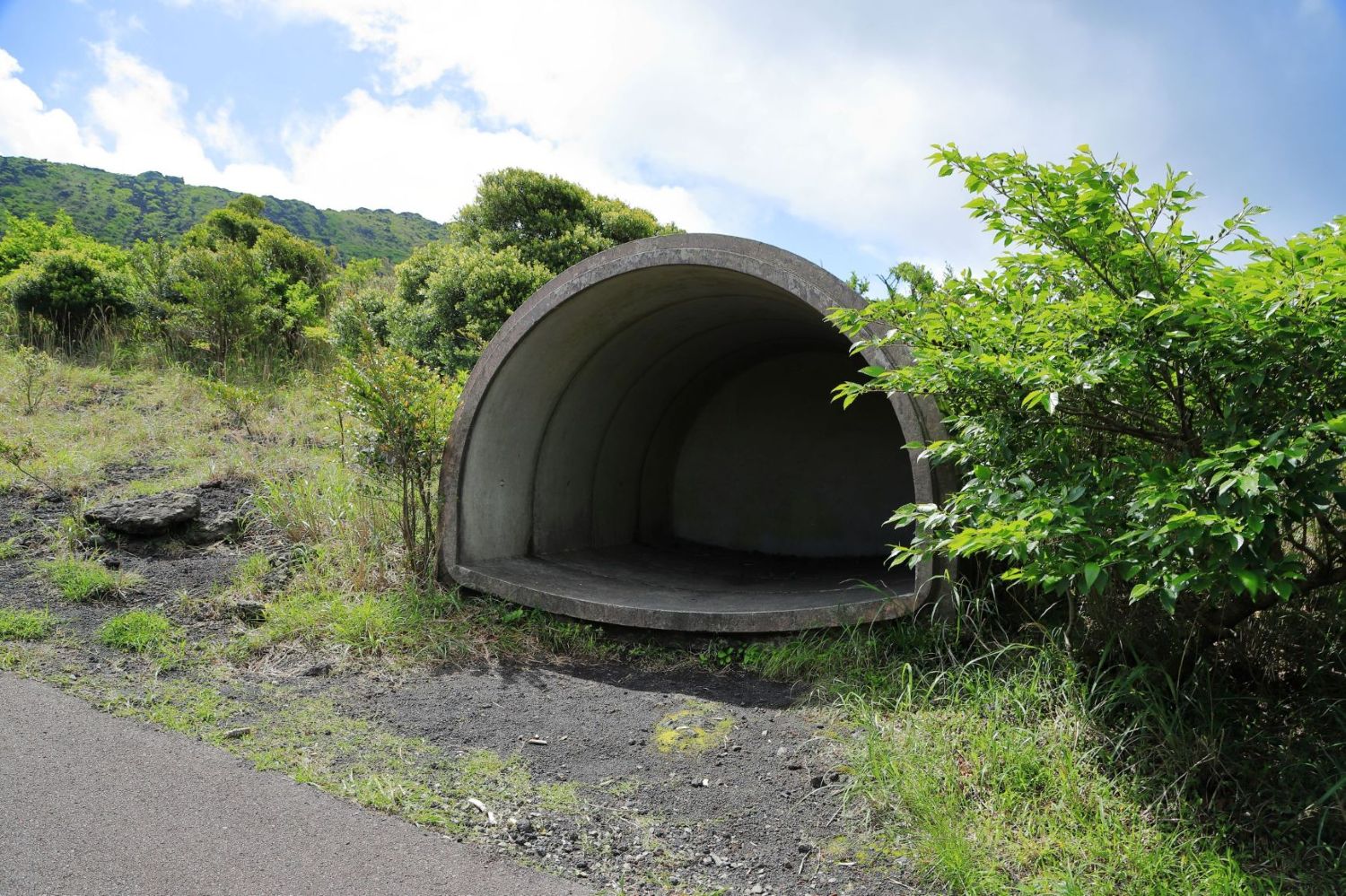
「退避壕」 is a volcanic evacuation facility to temporarily protect yourself from falling rocks. It differs from overnight shelters. This is an example from JMA Mt. Mihara guidance; it does not mean other volcanoes have the same facilities or that you can enter them now.
Credit: Japan Meteorological Agency 「三原山に登る観光客のみなさまへ」 · PDL1.0 · Used unchanged · Terms of use
Sources and terms checked:
What if volcanic ash falls on the city or accommodation?
Close windows to keep ash from entering indoors. If you must be outside, protect yourself with dust masks and dust goggles. If you received evacuation instructions, do not stay indoors — move according to those instructions.
Inhaling volcanic ash can cause coughing or breathing difficulty. If it gets in eyes, they may itch, hurt, or redden — do not rub them. Even with masks and goggles, do not enter restricted craters or places with volcanic gas.
JMA volcanic ash forecasts (降灰予報) tell where and how much ash will fall. Check the issued time to see if your area is included and how much is expected. Winds can cause the actual location and amount of ashfall to differ from the forecast.
If the forecast says 「多量」 (heavy), much ash is expected. Refrain from outings and driving then. If ash obscures visibility, consider stopping sightseeing or rental car travel. Wet ash on roads can be slippery.
- Volcanic ash forecast meaning and what to do (in Japanese) ↗
- JNTO · How to protect yourself from volcanic ash (in Korean) ↗
Official sources: JNTO · Protecting respiratory system and eyes from volcanic ash (in Korean) ↗ · Japan Meteorological Agency · Meaning of volcanic ash forecasts (in Japanese) ↗ · Japan Meteorological Agency · What to do by ash fall amount (in Japanese) ↗ · Japan Meteorological Agency · Eruptions and volcanic ash at Mt. Mihara (in Japanese) ↗ · Tokyo Metropolitan Government · Protecting yourself and road cautions in ash fall (in Japanese) ↗
Sources checked:
Can I continue traveling after an eruption?
If you received evacuation guidance, stop sightseeing and evacuate first. Then check whether you can stay at your accommodation and whether transport to your next destination runs. One volcano's alert level alone cannot tell you whether to cancel or continue your whole Japan trip.
Where ash has piled up, rain can cause mudflows of soil and rocks — watch for those too. Do not look only at eruption warnings; also check heavy rain information and new local government notices.
Before setting out, re-check the latest guidance from your accommodation and transport. Having a booking does not mean you can enter your accommodation now or that trains/buses run.
- In local government guidance, check whether your location and accommodation are evacuation targets. If your accommodation is in an evacuation zone or the route is closed, do not set out to return.
- From a safe place, call your accommodation to ask whether you can stay today and whether routes there are closed. If you cannot stay, follow the area's evacuation guidance to find somewhere to stay.
- Check on the airline website or app whether your booked flight departs. Separately check whether trains/buses to the airport run and whether roads are blocked. Even if your flight is scheduled to operate, you may be unable to reach the airport.
- If unsure whether you can stay at your accommodation or reach your next destination, reduce volcano-area plans first. If you need to change or cancel bookings, ask the booked company about conditions. A disaster does not make every booking free to cancel.
- Find evacuation guidance and open shelters for your area →
- What to do when flights are delayed or cancelled →
- Look up transport options in Japan →
- JNTO · Official disaster and transport sites ↗
Official sources: Japan Meteorological Agency · Volcano warning terms and cautions (in Japanese) ↗ · JNTO · What to do when eruption warnings are issued (in Korean) ↗ · JNTO · Official disaster and transport sites ↗
Sources checked:
Who do I call if I am hurt or need help?
If you need an ambulance or urgent fire help, call 119. After evacuating to a safe place, if you would like to explain travel difficulties in English, call the JNTO traveler support line.
When the call connects, tell them the volcano name, nearby facilities, and trail sign names. If someone is hurt, describe their condition too. If hard to explain your location or communicate, ask nearby staff to help with the call.
JNTO traveler support line is 050-3816-2787. Available 24 hours daily in Korean, English, and Chinese. From abroad, +81-50-3816-2787. If you need an emergency ambulance, call 119 before JNTO.
If you cannot stay at your accommodation, tell shelter staff so. If you need water, medicine, or an interpreter, tell them what you need. Supplies or interpretation cannot be guaranteed immediately.
Official sources: JNTO · Traveler support line and emergency contacts ↗
Sources checked:
Related guides
FAQ
Do eruption alert levels always rise from 1 to 5 in order?
Not necessarily in order. Eruptions can occur without clear anomalies observed. Even at level 1, do not enter restricted areas. If you witness an eruption, do not wait for alerts — protect your head and body.
Official sources: Japan Meteorological Agency · Volcano warning terms and cautions (in Japanese) ↗ · Japan Meteorological Agency · What to do when you receive an eruption bulletin (in Japanese) ↗
Sources checked:
Must I descend immediately when I receive an eruption bulletin?
It depends on the situation. If you can descend, do so immediately; if rocks are falling and you must take shelter first, take shelter in a nearby evacuation facility, hut, or behind rocks. Do not automatically run for a distant descent route; move away from the crater following on-site guidance.
Official sources: Japan Meteorological Agency · What to do when you receive an eruption bulletin (in Japanese) ↗ · Japan Meteorological Agency · Eruptions and volcanic ash at Mt. Mihara (in Japanese) ↗ · JNTO · What to do when a volcano erupts before your eyes (in Korean) ↗
Sources checked:
Should I close windows even when little ash falls?
Yes. JMA advises closing windows even when little ash falls. Outside, protect yourself with dust masks and dust goggles; if ash gets in your eyes, do not rub them. If you are told to evacuate, evacuation takes priority over closing the windows and staying indoors.
Official sources: Japan Meteorological Agency · What to do by ash fall amount (in Japanese) ↗ · JNTO · Protecting respiratory system and eyes from volcanic ash (in Korean) ↗ · Japan Meteorological Agency · Eruptions and volcanic ash at Mt. Mihara (in Japanese) ↗ · JNTO · What to do when eruption warnings are issued (in Korean) ↗
Sources checked:
Can I return to restricted observatories when eruptions calm down?
Do not enter restricted areas just because crater smoke decreased. Check whether local governments or facilities say you may return. Even at the same level, restricted ranges differ by volcano, so do not apply another mountain's guidance.
Official sources: Japan Meteorological Agency · Volcano warning terms and cautions (in Japanese) ↗ · Japan Meteorological Agency · Meaning of eruption warnings and forecasts (in Japanese) ↗ · Ministry of the Environment · Where not to enter at Mt. Aso and climbing prep (in Japanese) ↗
Sources checked:
When eruption warnings are lifted, are other dangers over too?
No. Where ash has piled up, rain can cause mudflows — dangers not known from eruption warnings alone. Check heavy rain information and local evacuation guidance, and do not enter areas closed on site.
Official sources: Japan Meteorological Agency · Volcano warning terms and cautions (in Japanese) ↗ · JNTO · What to do when eruption warnings are issued (in Korean) ↗
Sources checked:
Can I get travel assistance in English in Japan?
JNTO traveler support line 050-3816-2787 is available 24 hours daily in Korean, English, and Chinese. If you need an ambulance or urgent fire help, call 119 first. Contacting JNTO does not mean rescue, shelter supplies, or interpretation will be provided immediately.
Official sources: JNTO · Traveler support line and emergency contacts ↗
Sources checked:
Official sources for this guide
Check local notices for current warnings and access restrictions. For whether trains and flights are running, see the transport operators' latest notices.
Official sources: Japan Meteorological Agency · Meaning of eruption alert levels (in Japanese) ↗ · Japan Meteorological Agency · Volcano warning terms and cautions (in Japanese) ↗ · Japan Meteorological Agency · What to do by alert level (in Japanese) ↗ · Japan Meteorological Agency · Meaning of eruption warnings and forecasts (in Japanese) ↗ · Japan Meteorological Agency · What to do when you receive an eruption bulletin (in Japanese) ↗ · Japan Meteorological Agency · Eruptions and volcanic ash at Mt. Mihara (in Japanese) ↗ · Japan Meteorological Agency · Warnings and activity info by volcano (in Japanese) ↗ · Japan Meteorological Agency · Hazard zones and evacuation maps by volcano (in Japanese) ↗ · Japan Meteorological Agency · Meaning of volcanic ash forecasts (in Japanese) ↗ · Japan Meteorological Agency · What to do by ash fall amount (in Japanese) ↗ · JNTO · What to do when eruption warnings are issued (in Korean) ↗ · JNTO · What to do when a volcano erupts before your eyes (in Korean) ↗ · JNTO · Protecting respiratory system and eyes from volcanic ash (in Korean) ↗ · Ministry of the Environment · Where not to enter at Mt. Aso and climbing prep (in Japanese) ↗ · Tokyo Metropolitan Government · Protecting yourself and road cautions in ash fall (in Japanese) ↗ · JNTO · Traveler support line and emergency contacts ↗ · JNTO · Official disaster and transport sites ↗
Sources checked: