
What to do if you encounter heavy snow or blizzards while travelling in Japan
If heavy snow or a strong blizzard is expected, postpone going out sightseeing or driving. If you are already outside, do not push yourself to get back to your accommodation — take shelter in a nearby building you can enter. Follow the instructions of staff and on-site broadcasts, and if you are due to fly home, check your flight and the transport to the airport separately.
Official sources checked 2026-10-12
If you are in a blizzard right now
- If you cannot see ahead while walking, do not keep walking. If there is a shop or building nearby that you can enter, go inside, and cover your face and hands so no skin is exposed.
- If you cannot see well while driving, do not push on. If you can pull into a nearby rest facility, wait there until the weather improves.
- If the car will not move, switch on the hazard lights and call for rescue. If the car is buried in snow, the rule is to switch the engine off. The risk of exhaust-gas poisoning remains even with a window open.
- For an ambulance or emergency rescue call 119; for police help call 110. Tell them the location shown on your phone map, nearby landmarks and how many people are with you.
Official sources: Sapporo Regional Headquarters, Japan Meteorological Agency, and others · What to do in a blizzard (PDF, in Japanese) ↗ · Hokkaido · What to do in blizzards and when your car is stuck in snow (in Japanese) ↗ · JNTO · Traveller support hotline and emergency contacts (in English) ↗
Sources checked:
Japanese signs and guidance — how to read them
When you see the Japanese below on signs or phone alerts, check what it means. Do not look at the numbers alone — read together what danger it warns of and which area or section it applies to.
通行止
Meaning It means you must not enter that road.
What to do Do not enter a closed road. Check separately whether detour routes suggested by map apps are also closed, and follow on-site staff if they give instructions.
Even with winter tyres or chains, do not enter a closed road. A sign alone cannot tell you when the road will reopen.
Official sources: Sapporo Regional Headquarters, Japan Meteorological Agency, and others · Mini-note on preparing for blizzards (PDF, in Japanese) ↗
Checked:
外出は控えてください
Meaning It is a notice asking you to refrain from going out.
What to do Postpone outings for sightseeing and driving. If you are already outside, protect yourself in a nearby building you can enter and follow on-site guidance.
Do not push on even if the snow looks light or your accommodation seems close. Ask staff whether you can enter a nearby building and whether you can reach your accommodation.
Official sources: Sapporo Regional Headquarters, Japan Meteorological Agency, and others · Mini-note on preparing for blizzards (PDF, in Japanese) ↗
Checked:
運休
Meaning It means that train is not operating.
What to do Find your travel date, train and the suspended section in the notice. Check operator notices and station staff for whether you can take another train or bus.
This alone does not mean flights are cancelled too. Ask separately whether you can take a bus or taxi, and about changing bookings or refunds.
Official sources: JR Hokkaido · Train operating status by area and station (in Japanese) ↗
Checked:
運転見合わせ
Meaning It means train operations are temporarily suspended.
What to do Do not head out guessing when services will resume — read the affected sections and new notices. Ask station or accommodation staff where you can wait for now.
It does not mean services will resume soon. Only part of a line may be suspended, so read the section names as well.
Official sources: JR Hokkaido · Train operating status by area and station (in Japanese) ↗
Checked:
計画運休
Meaning It means a train service suspension has been decided in advance to prepare for weather and other conditions.
What to do Check new notices even if your booked train is on the timetable. See whether your travel date, train and section are included, and contact your accommodation too if you will arrive late or your plans change.
Even trains on the timetable can be suspended. Read the notice’s dates and affected sections, and ask the operator about changes and refunds.
Official sources: JR Hokkaido · Why services are suspended in advance (in Japanese) ↗
Checked:
暴風雪警報
Meaning It is a blizzard warning (暴風雪警報) issued when strong winds blow snow around so visibility drops and danger grows.
What to do Postpone outings and driving, and read the affected areas and issuing time. If blowing snow hides the road, do not keep moving.
It has a different meaning from 大雪警報 (heavy snow warning). This explains the Japanese terms; check the latest notices for warnings currently in effect.
Official sources: Japan Meteorological Agency · Types of weather warnings and advisories (in Japanese) ↗
Checked:
大雪警報
Meaning It is a heavy snow warning (大雪警報) issued when heavy snow may cause major damage or transport disruption.
What to do Check weather notices for the area and the guidance for the roads and transport you will use. Avoid unnecessary outings and driving.
It does not mean the same as a blizzard warning, and you cannot judge train or flight operations from warnings alone.
Official sources: Japan Meteorological Agency · Types of weather warnings and advisories (in Japanese) ↗
Checked:
Official sources: Sapporo Regional Headquarters, Japan Meteorological Agency, and others · What to do in a blizzard (PDF, in Japanese) ↗ · Hokkaido · What to do in blizzards and when your car is stuck in snow (in Japanese) ↗ · JNTO · Traveller support hotline and emergency contacts (in English) ↗
Sources checked:
If heavy snow is forecast, what should you pack before travelling?
Pack warm clothes and gloves, and winter shoes that do not slip easily. On days when heavy snow is expected, it is better to cut down on plans to travel far.
Japan’s Fire and Disaster Management Agency advises avoiding unnecessary outings when heavy snow or strong blizzards are expected, and not driving if possible. Before setting out, check when snow and wind will strengthen in the area you are visiting, and whether the roads you will use may close or transport may stop. The weather can turn bad suddenly even if it is clear now.
It is good to keep water and simple food at your accommodation in case you cannot go out. Charge your phone and power bank, and save your accommodation’s address and contact details. On the day you fly home, we recommend checking the way to the airport and transport first, rather than visiting tourist spots far from the airport.
If you must walk on snowy roads
Wear shoes that do not slip easily and allow plenty of time so you do not have to hurry. You can still fall even in winter shoes or with anti-slip gear, and you can lose your way in a blizzard.
If you rent a car
Ask the rental company whether winter tyres are fitted and chains are available, and learn how to use the chains. The Fire and Disaster Management Agency says a car can get stuck in snow even with winter tyres. Even with the equipment, postpone driving if a blizzard is expected.
Official sources: Fire and Disaster Management Agency · What to prepare before heavy snow and blizzards (in Japanese) ↗ · Sapporo Fire Bureau · Preventing falls on snowy roads (in Japanese) ↗ · Sapporo Regional Headquarters, Japan Meteorological Agency, and others · Mini-note on preparing for blizzards (PDF, in Japanese) ↗
Sources checked:
How is a heavy snow warning different from a blizzard warning?
It matters not only how much snow piles up, but also whether wind-blown snow blocks your view. Check which warnings were issued for the area you are visiting and when.
The Japan Meteorological Agency’s heavy snow warning (大雪警報) warns of major damage or transport disruption from heavy snow. A blizzard warning (暴風雪警報) warns of strong winds with snow and the danger of blowing snow hiding your view. Heavy snowfall and losing visibility in a blizzard are different dangers.
In the Agency’s heavy snow and blizzard information, open 「気象警報・注意報」 (weather warnings and advisories) and find the area you are visiting. It is also worth reading that area’s local weather information together. Do not set out based only on a snow-depth map or your phone’s weather icon. If you are told on site to stay in or evacuate, follow that guidance.
「気象防災速報(短時間大雪)」 is a short-time heavy snow bulletin issued when a lot of snow in a short time has made a major disaster much more likely. Avoid unnecessary outings in the areas it covers. Do not travel there even if you are elsewhere. If snow and rain are forecast together, or flooding or landslide guidance has been issued, also read what to do for heavy rain, floods and landslides.
Check current warnings with the Japan Meteorological Agency. Even after warnings are lifted or the snow stops, roads may be closed and trains or buses may still be stopped. Before setting out again, check the roads you will take and the transport you will use.
Official sources: Japan Meteorological Agency · Types of weather warnings and advisories (in Japanese) ↗ · Japan Meteorological Agency · Heavy snow and blizzard weather information (in Japanese) ↗ · Japan Meteorological Agency · Damage from heavy snow and warning guidance (in Japanese) ↗
Sources checked:
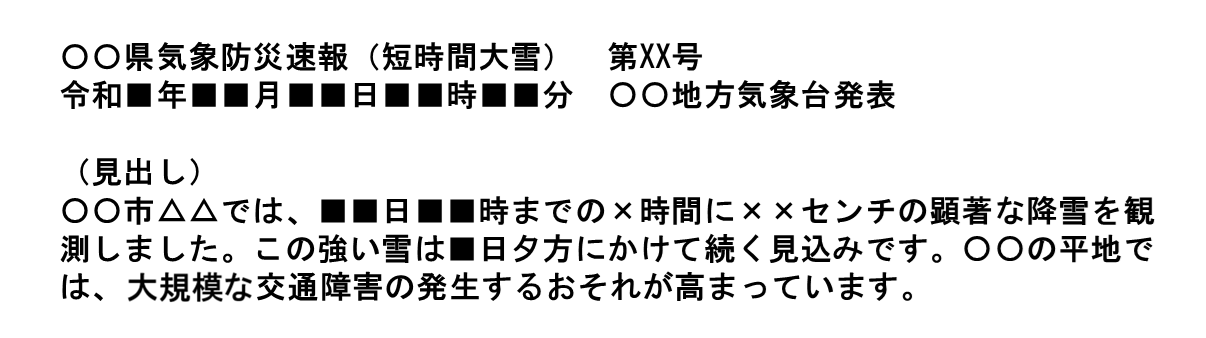
気象防災速報(短時間大雪) is a short-time heavy snow bulletin. First read the area and issuing time in the title, then look at 「×時間に×センチ」 in the body to see how many centimetres fell in how many hours. ○·△·■·× are placeholders where values go — they are not current warning information or nationwide criteria.
Source: Japan Meteorological Agency 「大雪に関する情報について」 · PDL1.0 · used unchanged · Terms of use
Sources and terms checked:
Can I still walk to my accommodation if the blizzard gets worse?
If you cannot tell the road or direction apart, do not keep walking even if your accommodation is close. Take shelter in a nearby building you can enter.
The weather office explains that when a blizzard turns everything white ahead, you can lose your sense of direction and not know where you are. Cover exposed skin such as your face and hands, and watch out for objects blown by the wind. If there is no building to enter and you need urgent rescue, call for help and state your current location.
Do not hurry even on snowy roads you can see. The Sapporo Fire Bureau advises taking short steps and walking as if pressing the whole sole of your shoe to the ground. Lift your feet slightly as you move — dragging them along the ground can trip you. Do not walk while looking at your phone. In a blizzard so bad you cannot see ahead, do not try to walk like this — find shelter first.
Official sources: Sapporo Regional Headquarters, Japan Meteorological Agency, and others · What to do in a blizzard (PDF, in Japanese) ↗ · Sapporo Fire Bureau · Preventing falls on snowy roads (in Japanese) ↗ · JNTO · Traveller support hotline and emergency contacts (in English) ↗
Sources checked:
Can I keep driving if I have winter tyres fitted?
Even with winter tyres, do not push on if you cannot see ahead well or the car is blocked by snow. Postpone setting out when a blizzard is expected.
- Before leaving, first check the forecast for the area you are visiting and whether the roads you will use are closed. Ask the rental company whether you can change your pick-up or return dates.
- If you must drive, load warm clothes and gloves, a shovel, water and food, and prepare enough fuel. A car can get stuck in snow even with winter tyres, so take chains too.
- If blowing snow hides your view while driving, do not push on to your destination. If you can pull into a nearby rest facility, wait there until the weather improves.
Do not assume you can just take a rental car or taxi because trains have stopped. Heavy snow can close roads or trap cars in snow. To switch to other transport, check separately whether that transport is running and whether the roads you will use are open.
Official sources: Fire and Disaster Management Agency · What to prepare before heavy snow and blizzards (in Japanese) ↗ · Hokkaido · What to do in blizzards and when your car is stuck in snow (in Japanese) ↗ · Japan Meteorological Agency · Damage from heavy snow and warning guidance (in Japanese) ↗
Sources checked:
If my car is stuck in snow, can I keep the engine on and wait?
If the car is buried in snow, the rule is to switch the engine off. If snow blocks the exhaust (where exhaust gas comes out), exhaust gas can enter the car and cause carbon monoxide poisoning.
- Switch on the hazard lights and call for rescue. If you need urgent rescue, call 119 or 110 and state your current location and that the car is buried in snow.
- Do not leave the car and walk in a blizzard when you do not know where to go. Hokkaido advises that if there is no building or nearby house to shelter in, you should contact the police or fire service and wait in the car for rescue.
- Switch the engine off and wrap yourself in warm clothes and a blanket. Your body temperature can drop if you stay in the car a long time, and exhaust gas can enter if you leave the engine on — watch out for both dangers.
- If you must switch the engine on to stay warm, the exhaust must be completely clear of snow and open to the outside. Keep checking that newly falling or wind-drifted snow does not block the exhaust again. If going outside to clear snow is dangerous, do not push yourself — tell the rescue staff about your situation.
Do not feel safe just because you opened a window slightly or cleared snow from around the exhaust once. The weather office warns that opening a window can actually raise the risk of carbon monoxide poisoning depending on wind direction and how far the window is open.
Official sources: Hokkaido · What to do in blizzards and when your car is stuck in snow (in Japanese) ↗ · Sapporo Regional Headquarters, Japan Meteorological Agency, and others · What to do in a blizzard (PDF, in Japanese) ↗ · JNTO · Traveller support hotline and emergency contacts (in English) ↗
Sources checked:
Once the snow stops, can I head straight for the airport or the next city?
Do not set out right after the snow stops. Check separately whether your booked flight is departing and whether trains or buses to the airport are running, and decide where you will stay for now.
Heavy snow can cancel train services (suspensions) or stop planes from flying. Roads may be closed and power cuts may occur. JR Hokkaido sometimes cancels train services in advance to reduce trains getting stuck between stations or stations becoming congested because of snow or rain. This is called 「計画運休」 (planned service suspension). Even trains on the timetable may not run on the day.
If you cannot travel and will arrive late at your next accommodation, contact them first. Ask whether you can change your arrival date, and ask your current accommodation whether you can stay longer and what the extra charge is. Room and meal provision, and waiving cancellation fees, depend on your booking conditions and the accommodation’s answer. It is good to keep change notices and the accommodation’s replies.
- Find your flight number and departure date on the airline’s website or app. Check whether the plane is flying and whether the departure time has changed — an open airport does not mean your flight is departing.
- For trains or buses to the airport, find your section with the operator. Check when cancellation or delay notices were issued too. In Hokkaido you can find your area and station in JR Hokkaido’s operating information.
- If you cannot travel or cannot stay at your accommodation, ask staff where you can wait or get help. Find currently open facilities in that city’s official evacuation information, and check whether you can get there.
- Check with JR Hokkaido whether your train is running (in Japanese) ↗
- What to do when flights are delayed or cancelled →
- Getting around Japan by public transport →
- Finding currently open shelters by city →
Official sources: Japan Meteorological Agency · Damage from heavy snow and warning guidance (in Japanese) ↗ · JR Hokkaido · Why train services are cancelled in advance (in Japanese) ↗ · JR Hokkaido · Train operating status by area and station (in Japanese) ↗ · JNTO · Traveller support hotline and emergency contacts (in English) ↗
Sources checked:
If I cannot explain myself in Japanese, where can I ask for help?
If you need an ambulance or urgent fire-service help, call 119. If a disaster has caused difficulties during your trip, you can ask for help from the JNTO traveller support hotline.
The JNTO number is 050-3816-2787 inside Japan and +81-50-3816-2787 from abroad. It offers travel information and help with accidents, illness and disasters in Korean, English and Chinese, 24 hours a day, every day. If you need urgent rescue or an ambulance, call 119 before JNTO.
Tell staff your current location, why you cannot get back to your accommodation, how many people are with you and what help you need. If it is hard to explain, show them your accommodation address or booking screen saved on your phone. Ask staff if you need a place to stay, supplies, medicines or interpretation. You need to ask on site whether everything you need can be provided.
Official sources: JNTO · Traveller support hotline and emergency contacts (in English) ↗ · Hokkaido · What to do in blizzards and when your car is stuck in snow (in Japanese) ↗
Sources checked:
Related guides
Frequently asked questions
Where can I see heavy snow forecasts for Sapporo?
In the Japan Meteorological Agency’s heavy snow and blizzard information, open 「気象警報・注意報」 (weather warnings and advisories) and the Hokkaido local weather information. Find Sapporo and check what forecasts or warnings were issued and when. Check separately with each operator whether planes or trains are running. Do not assume you can set out based only on a snow-depth map.
Official sources: Japan Meteorological Agency · Heavy snow and blizzard weather information (in Japanese) ↗ · Japan Meteorological Agency · Damage from heavy snow and warning guidance (in Japanese) ↗
Sources checked:
If the train to the airport stops, will my flight be cancelled too?
Even if trains stop, planes can still fly, so check each separately. Find your flight number and departure date on the airline’s website or app, and find your section with the operator for transport to the airport. Even after the snow stops, check that transport is running again before moving.
Official sources: Japan Meteorological Agency · Damage from heavy snow and warning guidance (in Japanese) ↗ · JR Hokkaido · Train operating status by area and station (in Japanese) ↗
Sources checked:
Can I drive in a blizzard if I have winter tyres and chains?
Do not assume the equipment makes it safe to go. The Fire and Disaster Management Agency says a car can get stuck in snow even with winter tyres. Avoid unnecessary outings and driving when heavy snow or strong blizzards are expected. If you cannot see ahead well while driving, do not push on.
Official sources: Fire and Disaster Management Agency · What to prepare before heavy snow and blizzards (in Japanese) ↗ · Sapporo Regional Headquarters, Japan Meteorological Agency, and others · What to do in a blizzard (PDF, in Japanese) ↗
Sources checked:
If I open the window in a snow-buried car, can I keep the engine on?
The risk of carbon monoxide poisoning remains even with a window open. If the car is buried in snow, the rule is to switch the engine off. Even when you must switch it on to stay warm, keep checking that the exhaust is fully open to the outside and snow does not block it again. Even so, safety cannot be guaranteed. Tell the rescue staff about your current situation.
Official sources: Hokkaido · What to do in blizzards and when your car is stuck in snow (in Japanese) ↗ · Sapporo Regional Headquarters, Japan Meteorological Agency, and others · What to do in a blizzard (PDF, in Japanese) ↗
Sources checked:
Can I walk to my accommodation in a blizzard if it is close?
If you cannot see ahead or cannot tell direction, do not keep walking even if your accommodation is close. Take shelter in a nearby building you can enter, and cover exposed skin such as your face and hands. If there is nowhere to shelter and you need urgent rescue, call 119 or 110, state your current location and situation.
Official sources: Sapporo Regional Headquarters, Japan Meteorological Agency, and others · What to do in a blizzard (PDF, in Japanese) ↗ · JNTO · Traveller support hotline and emergency contacts (in English) ↗
Sources checked:
Official sources for this guide
Check current warnings and access restrictions in notices for the area. For whether trains and flights are running, see the latest notices from transport operators.
Official sources: Sapporo Regional Headquarters, Japan Meteorological Agency, and others · What to do in a blizzard (PDF, in Japanese) ↗ · Hokkaido · What to do in blizzards and when your car is stuck in snow (in Japanese) ↗ · Fire and Disaster Management Agency · What to prepare before heavy snow and blizzards (in Japanese) ↗ · Sapporo Fire Bureau · Preventing falls on snowy roads (in Japanese) ↗ · Japan Meteorological Agency · Types of weather warnings and advisories (in Japanese) ↗ · Japan Meteorological Agency · Heavy snow and blizzard weather information (in Japanese) ↗ · Japan Meteorological Agency · Damage from heavy snow and warning guidance (in Japanese) ↗ · JR Hokkaido · Why train services are cancelled in advance (in Japanese) ↗ · JR Hokkaido · Train operating status by area and station (in Japanese) ↗ · JNTO · Traveller support hotline and emergency contacts (in English) ↗
Sources checked: